
Vallejo, CA · Garage Door Service
When a Spring Goes in Cold Weather in Vallejo
Why Vallejo's older torsion springs let go on cold mornings, what the mild climate here actually changes, and what it costs to fix versus wait.
- Repairs & new doors
- Springs & openers
- Serving 8 nearby communities
What Is Going On
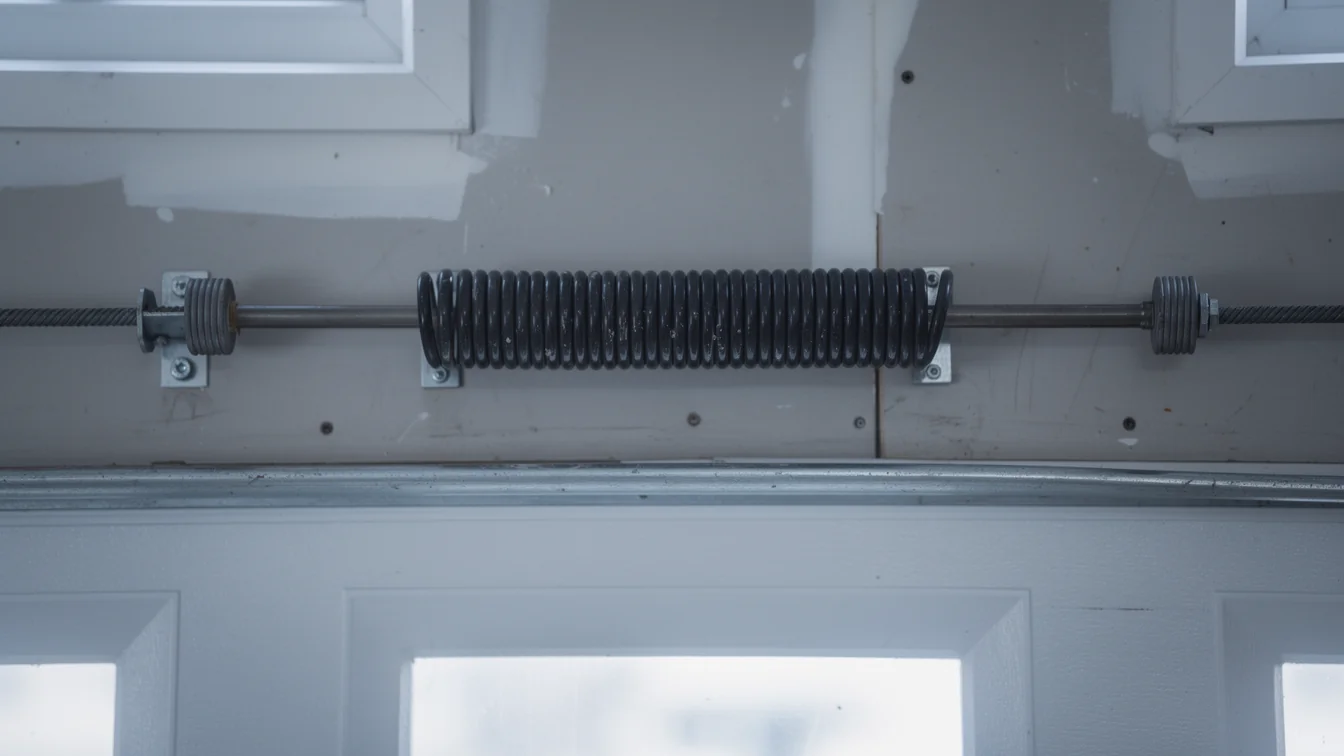
A torsion spring stores tension by twisting around a steel shaft above the door. Steel contracts in the cold, and a spring that's already fatigued from decades of cycles has less give left when that happens. That's the mechanical story everywhere. What makes it specific here is the housing stock: across this service area, homes went up between 1938 and 1996, with the median landing in 1967, and most of what we're called out to is 1960s and 70s construction. A spring installed when a house like that was built has had fifty-plus years of daily cycles on it. By the time a cold morning adds extra load, a lot of those springs are already down to their last few winds.
We see this most on original one-piece doors still running the torsion hardware that came with the house. Nobody's replaced the spring since, because nothing failed loudly enough to call anyone. Then one cold morning the door won't lift, or it drops fast on the way down, and the spring's gone. It's not really a cold-weather problem. It's a fifty-year-old-metal problem that cold weather happens to expose.
What the Weather Here Does to It
Vallejo sits in a mild temperate band, not a hard-freeze climate. That matters because it changes what's actually driving the failure. In a place with real winters, you'd blame the cold snap itself - ice load, deep freeze, metal that's genuinely brittle from sustained low temperatures. Here, the morning dip tightens the coil a little and adds a bit more resistance to a spring that's already near the end of its cycle life, but it's rarely the cold alone doing the damage.
What that means for a homeowner: if your spring breaks on a cold morning in this service area, the weather was the trigger, not the cause. The cause is almost always the age of the spring relative to the age of the door, especially on the 1960s and 70s stock that makes up most of what's out there. A door that's been opened and closed twice a day since the Johnson administration doesn't need a cold snap to fail - it just happens to pick a cold morning to do it, because that's when the extra resistance tips a tired spring over the edge.
What It Costs
I don't have a flat number to hand you here, because spring cost depends on the door's weight and whether it's running one spring or two, and that varies house to house even within the same subdivision. What I can tell you from the housing stock itself: a lot of the original doors from the 1960s and 70s era were built heavier than what goes in today, which usually means a heavier-duty torsion spring than a standard new door would need. That pushes the part cost up a notch, though not the labor.
Median household income across this service area runs $130,583, which puts a spring replacement well within normal reach for most owners here - it's not a decision that usually needs financing. Where cost climbs is if the spring failure took the cable or the drum with it, or if the door's old enough that the track and rollers are due too. At that point you're not pricing a spring anymore, you're pricing a small overhaul, and it's worth asking for both numbers before you commit to either.
When Waiting Is Fine
If the spring is just noisy - a squeak or a shudder on the way up - that's wear, not failure, and it's fine to wait and get it looked at on a normal schedule. Same if the door still opens and closes evenly but feels a little heavier than it used to. That's a spring losing tension gradually, and gradual is manageable.
What's not fine to wait on: a door that's noticeably uneven, lifts unevenly on one side, or a cable that's frayed or already slipped off the drum. On a two-spring door, one spring going usually means the other is close behind, since they were wound at the same time and carried the same fifty-plus years of cycles. If you've got an original torsion setup from the 1960s or 70s and one side just went, I'd rather replace both now than send someone back out in three months for the second one. That's a judgment call, not a rule, but it's the one I'd make on my own house.
Frequently asked questions
Why did my spring break on a cold morning if Vallejo doesn't really get hard freezes?
Because the cold isn't the real cause, it's the trigger. A spring that's fifty-plus years old is already near the end of its cycle life. The slight extra resistance from a cooler morning is often just enough to push a tired spring past its limit. The underlying problem is age, not weather.
Do I need to replace both springs if only one broke?
Not always, but on a two-spring door where both were installed the same year, the second one usually isn't far behind the first. If your door is original to a 1960s or 70s build, I'd lean toward replacing both at once rather than paying for two separate service calls.
How do I know if my spring is original to the house?
If nobody's told you it's been replaced, and the house hasn't had other garage door work done, it's probably original. Given that most of the housing stock in this area dates to the 1960s and 70s, that often means the spring is well past the point where replacement makes more sense than another repair.
Related garage door services in Vallejo
More garage door guides
Book garage door service in Vallejo
Call now or request a quote - tell us what the door is doing and where you are.